
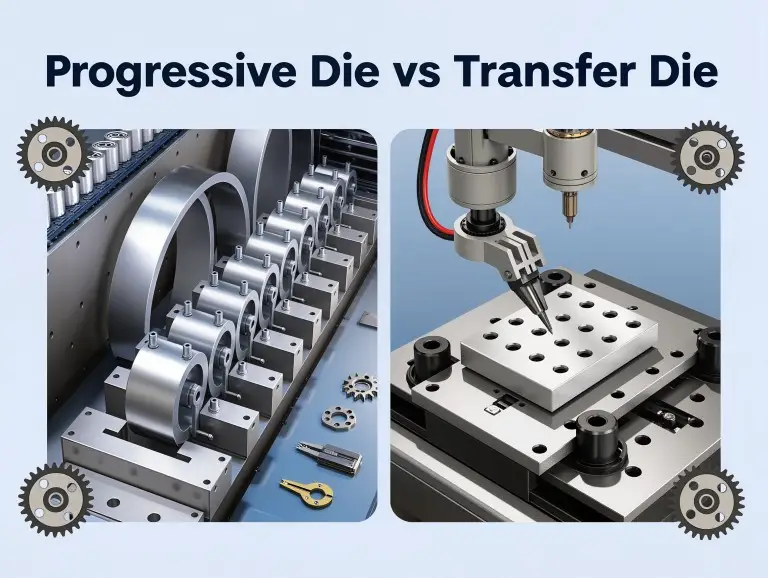
In metal stamping, progressive dies and transfer dies are essential tools for efficiently producing precision components. Progressive dies excel in large-scale production of small, simple parts. They work by feeding metal coils through multiple stations in a single die set, enabling high-speed automated operations.
On the other hand, transfer dies are better suited for large or complex parts. They move individual blanks between independent stations or dies. While transfer dies operate at a slower speed, they offer greater flexibility and better material utilization.
Industry data shows that progressive dies can produce hundreds of pieces per minute in high-volume scenarios. Meanwhile, transfer dies shine in specialized processes like deep drawing.
For manufacturers seeking reliable Metal Stamping Services, understanding the differences between these two methods is crucial for making informed decisions. This article explores their mechanisms, pros and cons, key differences, and practical applications to help manufacturers choose the right solution.
Overview of Transfer Molds
Transfer dies have changed the way we shape and form metal parts, as they are an important part of metal stamping. Let’s take a look at the specifics of these dies to see how they work, what their advantages are, and what disadvantages they may have.
How Transfer Dies Work
A transfer die is a set of independent stamping stations, each of which performs a different job on a metal part. The process begins by cutting a blank from a metal coil. Then, mechanical fingers or feeders move the blank from one place to another.
Each station performs a different task, such as punching, bending, or cutting. By the time the part reaches the final station, it has been transformed into a finished component. This step-by-step method allows complex parts to be manufactured quickly and accurately.
Advantages of Transfer Dies
- Complex part production: Transfer dies are perfect for making complex parts that require multiple steps.
- Efficient: Because each machine does a specific job, parts can be made quickly, making them ideal for high-volume production.
- Flexibility: Transfer molds are flexible because they can be changed or modified to make different parts.
- High Precision: Since the steps are performed sequentially, each movement is very precise. This results in consistent and high quality parts.
Disadvantages of Transfer Dies
- Initial setup costs: Designing and manufacturing transfer molds can be costly, especially for complex parts.
- Maintenance: Molds require regular servicing to keep them in good condition, which increases operating costs.
- Not suitable for small production runs: Transfer molds may not be the best choice for small production runs because of the high initial setup costs.
- Space required: Machines for transfer dies can be large, so manufacturing centers require a large footprint.
Overview of Progressive Dies
Progressive dies are a great example of how metal stamping has changed over time because it makes molding metal easier. Let’s explore together to learn more about these dies, their advantages and disadvantages, and the problems they can cause.
How Progressive Dies Work
A progressive die is a set of stamping stations set up in a certain order within a tool. As the metal strip passes through the die, each point in the die performs a different job, such as punching, bending, or forming. For each revolution of the press, the metal strip moves forward. When the metal strip comes out of the mold, a finished part is separated from the metal strip. This continuous action allows many parts to be in different stages of production at the same time, thus increasing the efficiency of the stamping process.
Advantages of Progressive Dies
- Speed and efficiency: these dies allow parts to be made quickly, making them ideal for high-volume production.
- Consistency: Since the production process is continuous, the quality and accuracy of each part are the same.
- Cost-effectiveness: The initial investment may be high, but because the process is so efficient, the cost of manufacturing individual parts is usually low.
- Low material waste: Progressive dies are made to maximize the use of the materials used, so there is very little waste.
Disadvantages of Progressive Dies
- Initial investment: The cost of constructing and manufacturing progressive dies can be high, especially if the design is complex.
- Complex setup: Installing and setting up a progressive die requires specialized skills and more time.
- Maintenance: Regular maintenance is required as the machine is in constant use and wears out quickly.
- Design limitations: Progressive die stamping cannot be used for all parts. Very complex parts may require additional steps or different stamping methods.
Differences Between Transfer and Progressive Dies
In the field of metal stamping, both transfer and progressive dies have their place. Although the purpose of both is to mold metal, they do it in different ways and with different results. Let’s put the two together and see how they differ and the problems they face.
Differences in Mechanisms and Application Mechanisms
First, the mechanism differences are shown in the following table:
| Aspect | Transfer Dies | Progressive Dies |
|---|---|---|
| Operation Method | Cutting blanks followed by station-by-station transfer | Continuous metal strip through a single set of tools |
| Station Design | Independent stations, mechanical transfer | Stations arranged in sequence within a single die |
| Speed | Slower, but flexible | High-speed, suitable for continuous production |
Passing dies and progressive dies differ in their application:
- Transfer dies: This type of die is used for larger parts or parts that need to be deep drawn or have a large amount of material passing through them.
- Progressive dies: Progressive dies are best suited for making small, simple shaped parts when a large number of parts need to be made quickly.
Reflections on Materials and Design
Material suitability:
- Transfer dies: These dies can process more types of material, even single bars that are difficult to process.
- Progressive dies: These dies are best suited for materials that are easy to machine into strips, such as thin metal sheets.
Design flexibility:
- Transfer dies: Offer more options for complex parts, especially those that require frequent remolding.
- Progressive dies: They can handle complex designs, but very complex parts may require additional work.
Cost Implications
Initial investment:
- Transfer dies: Designing and manufacturing transfer molds can be expensive, especially for complex parts.
- Progressive dies: The cost of the die may be high at first, but as the process improves, the cost per part usually decreases.
Operating costs:
- Transfer dies: If the mold requires maintenance or replacement, operating costs will increase.
- Progressive dies: will wear out over time and therefore require regular maintenance. However, high efficiency can reduce the total cost of producing parts in high volume.
How to Choose the Right Stamping Process?
At Yonglihao Machinery, we believe choosing between progressive dies and transfer dies depends on several key factors. Here’s a quick guide to help you decide:
- Part Complexity: Progressive dies are great for simple parts, but transfer dies handle complex features like threads, notches, or reinforcements more efficiently.
- Part Size: Small parts are best suited for progressive dies, while transfer dies excel with larger components or those requiring deep drawing.
- Production Volume: For high-volume production, progressive dies are faster and more cost-effective. Transfer dies are better for smaller or custom runs.
- Material Type: Thin, coiled materials work well with progressive dies. Transfer dies are ideal for thicker or harder-to-process materials.
- Budget: Progressive dies reduce costs per part in large batches. Transfer dies, while more expensive per unit, are better for low-volume or specialized projects.
- Space Requirements: Progressive dies require less floor space, making them suitable for compact workshops. Transfer dies need more room due to their larger equipment.
If you’re unsure which process fits your needs, our team at Yonglihao Machinery is here to guide you. We’ll evaluate your project and recommend the most efficient and cost-effective solution.
In Summary
Both transfer and progressive dies are important components in the complex metal stamping process. Each type of die brings its rhythm and style to the production floor.
Transfer dies are great when you need to make complex designs or make big changes to the shape of something. This is because they can carefully handle each part through its own station. Since they can handle many different materials and designs, they are the best choice for complex parts that need to be drawn in detail.
On the other hand, progressive dies are perfect for high-volume production. Because of their continuity and efficiency, they are especially suitable for parts with simple shapes. Their ability to produce large quantities of parts at high-quality levels and at a lower cost per part makes them ideal for many manufacturers.
However, both tools have their own issues that need to be addressed. It’s important to weigh the pros and cons against the needs of the project, from initial price to design constraints and maintenance costs.
FAQ
What is the main difference between progressive dies and transfer dies?
Progressive dies process continuous metal strips in a single die set, making them ideal for high-speed production of small, simple parts. Transfer dies move individual blanks between independent stations, making them better for large or complex parts. Progressive dies prioritize efficiency, while transfer dies offer flexibility and better material utilization.
When should progressive dies be used?
Progressive dies are best for large-batch production of small, simple parts, such as electronic connectors or automotive brackets. They enable high-speed, unattended operation, producing hundreds of pieces per minute. For orders over 100,000 pieces annually, they can reduce costs per piece by over 30%. However, they are not suitable for very complex shapes.
When are transfer dies more advantageous?
Transfer dies are ideal for large parts requiring deep drawing, complex geometries, or special processes like thread rolling. They are commonly used for aerospace shells and medical device components. Their ability to move parts between stations improves flexibility and material utilization, though at a slower speed.
What is the material utilization rate of progressive dies?
Progressive dies typically achieve a material utilization rate of 95% or higher. This is due to their optimized layout, which minimizes waste. However, transfer dies may achieve slightly higher utilization rates by handling blanks independently.
How do the costs of the two dies compare?
Progressive dies have higher initial costs but lower costs per piece in large-batch production. Transfer dies involve higher overall costs due to mechanical transfers and maintenance. However, their efficiency can offset these expenses in the right applications.


