Investment casting, or lost wax casting, is a precise process. It makes metal parts with complex shapes and clean surfaces. The results are highly repeatable. This method often requires less machining than other options. It is a good choice for designs with thin walls, tight curves, or fine details. It’s also great for internal passages. You can use it to combine several parts into a single casting.
This article explains the investment casting process step-by-step. It covers the benefits, limits, and common materials. It also shows where this process adds the most value. The goal is to help you answer two questions. First, is investment casting right for your part? Second, what should you control to get stable quality?
What Is Investment Casting (Lost Wax Casting)?
Investment casting creates a metal part inside a ceramic shell mold. It does this by replacing a wax pattern with melted metal. The ceramic shell is built on the pattern. This allows it to copy fine details and curves with accuracy. It also avoids the heavy parting-line cleanup seen in split molds.
Think of it as a form of precision replication. The pattern sets the geometry. The ceramic shell affects the surface quality. There is a trade-off. The pattern and shell are used only once. Building the shell takes time. So, the method is most valuable when it cuts down the total manufacturing effort. This includes machining, welding, assembly, and rework on the finished part.
Investment Casting Process Step-by-Step
Pattern & Tooling
A wax pattern is a physical copy of your part. It creates the baseline for dimensional accuracy. For production, patterns are often made by injecting wax into a tool. For prototypes or small batches, you can use CNC-machined wax. 3D-printed patterns can also shorten the lead time.
Key controls are pattern stiffness and stability. Thin ribs, large flat areas, or long, slender shapes may bend. This can happen during handling or shell building. Use fillets and avoid unsupported spans. Define clear datums early. If you need very tight geometry on key faces, plan to add machining stock there. This is often better than forcing extreme as-cast tolerances everywhere.
Tree Assembly
A “tree” joins many wax patterns to a central sprue. This allows many parts to be poured at once. The gating path guides how metal fills the cavities. It directly affects issues like incomplete fill, cold shuts, shrinkage, and inclusions.
Key controls are fill balance and feeding. Smooth transitions and stable flow are vital. Proper feeding of hot spots separates repeatable production from luck. Gating strategy often matters as much as the pattern itself. This is true when your part has thin sections or long flow paths.
Ceramic Shell Building
The wax tree is dipped repeatedly in ceramic slurry. It is then coated with refractory sand, called stucco, to build a shell. The first coat is critical. It drives feature transfer and base surface quality. Later coats add mechanical strength.
Key controls are slurry health and drying discipline. Viscosity, contamination, and humidity are common root causes of problems. Airflow and handling damage can also lead to shell cracks, flaking, and rough surfaces. Shell thickness is chosen based on alloy temperature, casting mass, and handling needs. There is no single “best” thickness.
Dewax & Burnout
Dewaxing removes the wax from the ceramic shell. This is often done with steam autoclaves or flash-fire methods. After dewaxing, the shell is fired in a process called burnout. This strengthens the ceramic. It also removes any residue that could cause gas defects or surface reactions.
Key controls are thermal shock and cavity cleanliness. Dewaxing should remove wax quickly without stressing the shell. Burnout should leave a clean cavity. If you see gas defects or surface reactions again and again, check your burnout control and shell cleanliness.
Pouring & Solidification
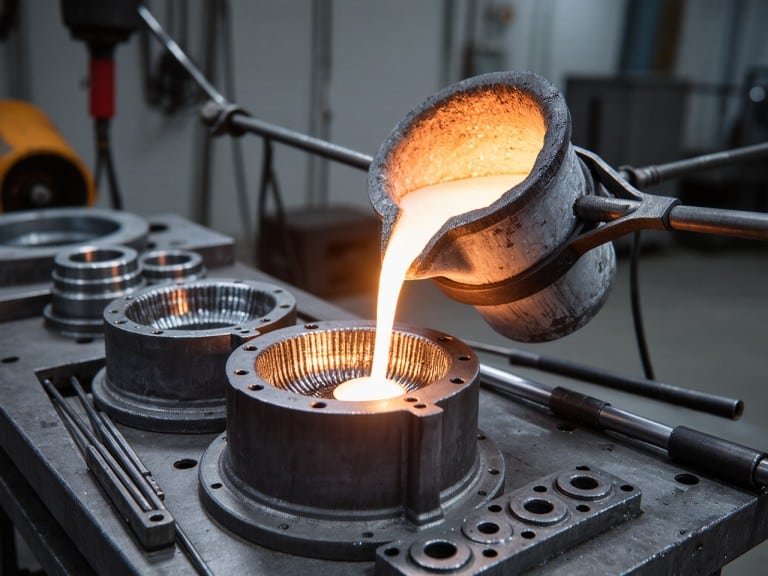
Molten metal is poured into the preheated shell. This is done with controlled methods like gravity or vacuum assist. Mold temperature and a stable pour help prevent the metal from freezing early. This is very important for parts with thin walls.
Key controls are the temperature window, cleanliness, and atmosphere. Turbulence can increase the risk of oxides and inclusions. Poor feeding raises the risk of shrink porosity. These are different problems with different fixes. Some alloys are sensitive to oxidation. They may need vacuum or inert gas protection to protect the surface.
Knockout, Cutoff & Finishing
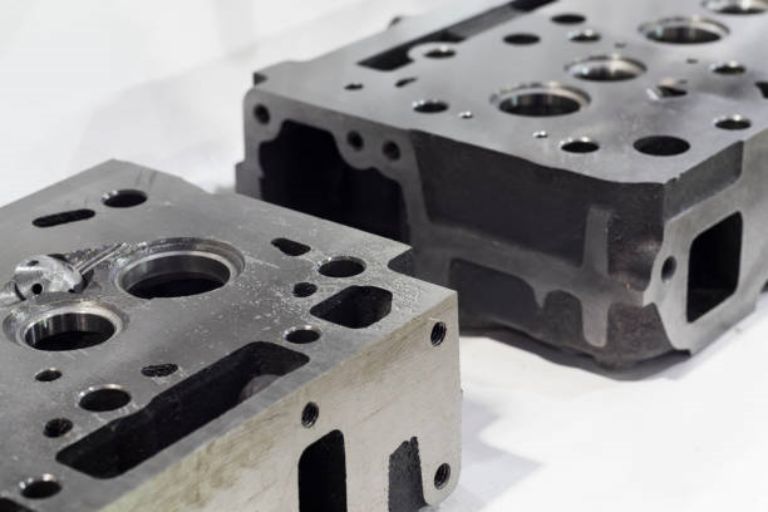
After the metal hardens, the ceramic shell is removed. This is done by vibration, impact, or water blasting. Parts are then cut from the gating system. They are cleaned and blended. Localized machining is used to meet critical functional tolerances.
The key control is defining finishing boundaries. Uncontrolled grinding can shift datums and soften edges. It can also create changes that look fine but fail during assembly. Protect reference surfaces. Define blend limits. Keep machining stock on critical faces so finishing is repeatable.
Inspection & Quality Control
Inspection confirms that castings meet all requirements. Dimensional checks target critical-to-quality features. Nondestructive testing (NDT) methods help find defects without damaging the part.
The key control is matching inspection to risk. Dye penetrant works well for surface-breaking cracks. Radiography helps find internal porosity and inclusions. Ultrasonic testing can be used for thicker sections. If the application is critical, define your rules up front. This includes traceability, heat/lot control, acceptance criteria, and rework policies.
Key Benefits of Investment Casting
Investment casting can deliver complex, near-net shapes with repeatable quality. This often cuts down on machining, setups, and assembly steps. Common benefits are fewer operations and more consistent geometry on complex curves. It also creates cleaner flow surfaces and reduces the need for welding multi-piece designs.
The limits are predictable. Tooling and pattern strategy require investment. Building the shell adds to the lead time. The method also needs strict process discipline. This includes shell drying, handling, melt cleanliness, and gating design. If a part is simple and easy to machine, investment casting might not be the most cost-effective path. However, if geometry drives up machining costs and quality risks, it often lowers the total cost and improves repeatability.
- Geometry is complex (thin walls, undercuts, internal features, curved surfaces).
- Surface integrity matters (for flow efficiency, sealing, or appearance).
- Part consolidation can replace welded or assembled parts.
- Repeatability is needed for small-to-medium production volumes.
- You can machine only what is truly needed, instead of machining everything.
Materials and Typical Performance Fit
Carbon and Alloy Steels
Choose carbon or alloy steels when you need strength and toughness at a reasonable cost. They are a good fit when geometry is too complex for cheap machining. These steels are common in industrial hardware and structural parts that benefit from a near-net shape.
Watch-outs: These steels often need corrosion protection. This is true in wet or chemical environments. Do not expect carbon steel to perform like stainless steel in corrosive service without some form of coating or plating.
Stainless Steels
Stainless steels are widely used for their corrosion resistance and cleanability. They also have good mechanical strength. Typical cast parts include pump housings, valve components, gears, and hardware for wet environments.
Watch-outs: “Stainless” is a family of metals, not a single choice. The right grade depends on the environment, including chlorides, acids, and temperature. It also depends on the stress the part will face. Match the grade, heat treatment, and inspection level to the actual use.
Aluminum Alloys
Aluminum alloys are good for lightweight structures with detailed shapes. They are often used in automotive and aerospace parts. Investment casting helps when you need complex curves or consolidated shapes that would otherwise require multiple machined pieces.
Watch-outs: Controlling thin-wall fill and distortion is sensitive. It depends on gating and thermal balance. Stable results come from good process control and smart design, not just the alloy.
Nickel/Cobalt Alloys
Nickel and cobalt alloys are for hot, oxidizing, or highly corrosive conditions. These are places where normal alloys would fail. These materials can be costly to machine. Investment casting complex shapes can greatly lower the total manufacturing effort.
Watch-outs: Melt cleanliness and atmosphere control become more critical. For extreme service, specify the heat treatment, inspection scope, and acceptance criteria. Do not rely on just the material chemistry.
Copper Alloys & Cast Iron
Copper alloys like bronze and brass are chosen for conductivity and heat transfer. They are also used for appearance and certain corrosion behaviors. Cast iron is often picked for its damping and wear properties in the right applications.
Watch-outs: Avoid sudden changes in section thickness. Design transitions carefully to reduce the risk of shrinkage. For critical parts, define the post-cast finishing and inspection to ensure consistency.
Where Investment Casting Creates the Most Value?
Aerospace
Aerospace requires consistent geometry, controlled defects, and high-performance alloys. Investment casting is a good fit for designs with complex shapes or tight clearances. It is also ideal for materials that are expensive to machine.
Common fit: brackets, housings, and complex components where repeatable geometry reduces risk.
Automotive
Automotive uses investment casting for parts that need to be durable and have repeatable geometry. It is good for reducing mass or part count. The process works well when a casting can replace a multi-piece assembly or a heavily machined part.
Common fit: turbo-related hardware, transmission components, and small, complex parts that need to be repeatable.
Medical
Investment casting can produce detailed parts that require consistent shapes. It is also good for parts that need well-defined inspection plans. It can be a fit for medical instruments and some implant-related parts where surface quality and traceability are important.
Common fit: small, detailed parts with controlled inspection and consistent manufacturing records.
Industrial & Energy
Industrial uses value the internal geometry and flow surfaces that are hard to machine. Investment casting is often used for valves, pump components, and parts that need both corrosion resistance and complex internal shapes.
Common fit: impellers, valve bodies, and flow-path parts where a near-net internal shape improves performance.
Marine
Marine environments create a high demand for corrosion resistance. They also require reliable sealing faces. Investment casting can produce complex shapes that are then finished precisely only where needed.
Common fit: corrosion-facing hardware and fluid-handling parts with defined, machinable sealing areas.
Surface Finishing Options After Casting
Investment castings often have a smoother starting surface than sand castings. But the final surface depends on the alloy, prime coat quality, and process control. You should specify a finishing route if you need good sealing, controlled friction, or a consistent look. Do not rely on “as-cast” results alone.
Finishing should be chosen based on its purpose. It must be controlled to protect datums.
- Anodizing (Al): improves corrosion resistance and appearance.
- Polishing: reduces roughness for looks or for functional flow surfaces.
- Painting / Powder coating: provides a uniform look and environmental protection.
- Passivation (stainless): improves corrosion resistance by stabilizing the surface.
A good practice is to state what is “as-cast acceptable.” Also, define what can be blended and what must be machined. This prevents uncontrolled handwork from becoming a hidden problem.
Conclusion
Investment casting is a proven way to make complex, repeatable metal parts. It offers strong surface replication and fewer downstream operations. The best results come when you treat it as a controlled system. This means stable patterns, disciplined shell building, and clean, stable pouring. It also means matching inspection to risk.
If you are evaluating a part, start with a simple list. Define the critical-to-quality features. Decide what must be machined. Clarify the alloy and heat treatment needs. If you partner with an experienced investment casting foundry, you can also get valuable guidance through each stage. Then, agree on an inspection plan for dimensions and NDT. Once those points are clear, investment casting becomes a predictable production process.
FAQ
What tolerances and surface finish can investment casting achieve?
It typically delivers tighter tolerances and smoother surfaces than sand molding. However, results depend on part size, alloy, and process discipline. For critical surfaces, it is common to cast near-net. Then, you machine datums, sealing faces, and holes to the final spec.
How do I know if my part is a good fit for lost wax casting?
It is a strong fit when geometry is complex. It’s also good if machining or fabricated assemblies would be costly, slow, or risky. Thin sections, internal passages, and curved shapes are common signs. This is true as long as you can accept the lead time for tooling and shell cycles.
Can 3D printing be used in the investment casting process?
Yes. 3D printing is often used to make patterns faster for prototypes or small batches. It reduces the need for tooling. But you still need to control the pattern’s accuracy, stability, and surface quality.
What are common defects in investment casting, and how do they map to process stages?
Most defects trace back to filling, feeding, shell integrity, or cleanliness. Use the map below to find the likely root cause based on the symptom.
|
Defect |
What you see |
Common process cause |
Correction direction |
|---|---|---|---|
|
Gas/shrink porosity |
Voids, pinholes |
Gas pickup, hot spots, poor feeding |
Improve melt practice, gating/feeding, temperature control |
|
Cold shut / misrun |
Unfilled edges/lines |
Early freezing, weak flow path |
Raise mold/metal temp, stabilize pour, adjust gating |
|
Shell crack / metal leak |
Flash, leaks, distortion |
Drying/handling stress, thermal shock |
Improve drying control, shell build, dewax/firing profile |
|
Inclusions |
Hard/dirty areas |
Oxides/slag, shell fragments |
Reduce turbulence, improve cleanliness, strengthen shell |
Is investment casting environmentally friendly?
It can reduce waste by recovering wax and metal. But energy use and emissions must be managed. Key steps to lower the environmental impact are effective fume control, responsible shell waste handling, and efficient melting.
What is the biggest cost driver in investment casting projects?
The biggest drivers are tooling, yield (gating and scrap), and finishing time. The fastest way to control cost is to stabilize your yield. You also want to prevent heavy manual grinding from becoming the main variable.
How can I make my design more “investment-casting friendly”?
Use smooth transitions and avoid sudden jumps in section thickness. Define realistic tolerances for critical features with clear machining datums. This reduces hot spots, improves fill stability, and makes finishing and inspection more predictable.