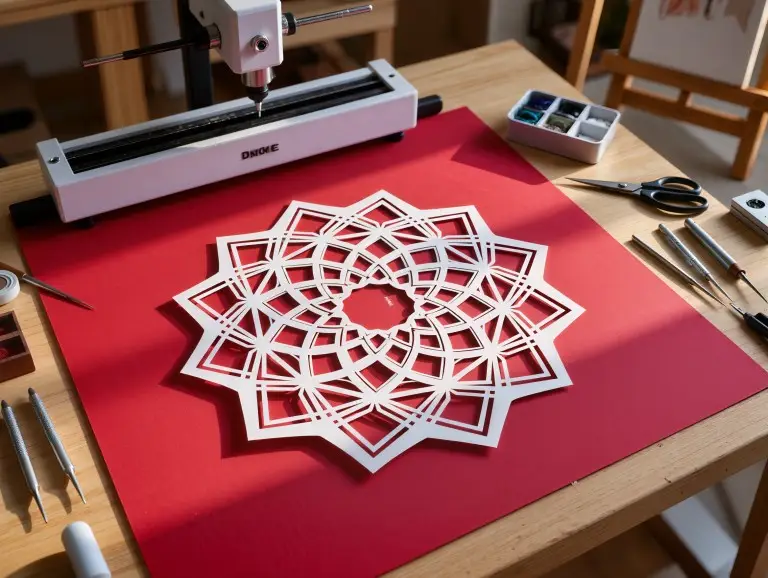
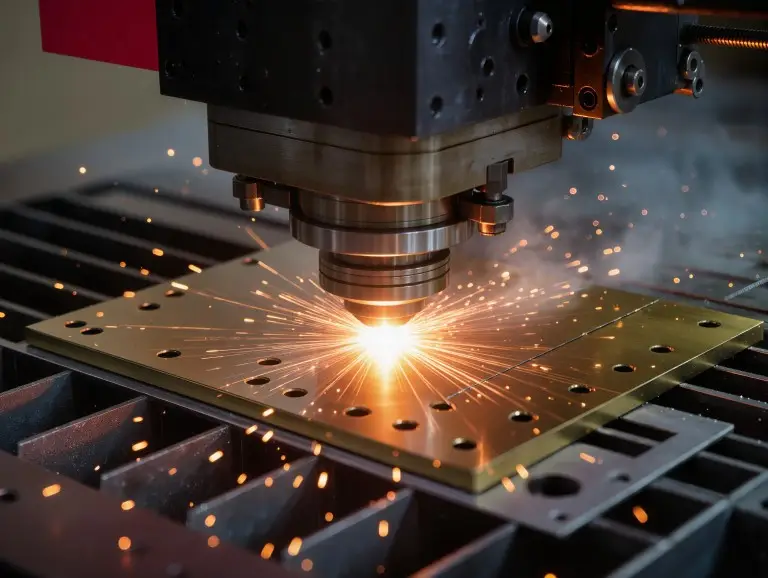
At Yonglihao Machinery, a leading prototyping company, we use sheet metal laser cutting for parts needing clean geometry, repeatable accuracy, and fast turnaround. Our laser cut services are practical for brackets, covers, enclosures, and machine frames. They also work for many other flat-pattern components.
In this article, I will focus on one question: what is sheet metal laser cutting? I will also explain what you should expect from it. You’ll learn about the main laser types and common cutting modes. We will also cover key benefits, limits, and some design rules to prevent expensive rework.
What Sheet Metal Laser Cutting Is?
Sheet metal laser cutting is a thermal cutting process controlled by a CNC. It uses a focused laser beam to melt or vaporize metal along a programmed path. This separates a net-shape profile from a sheet.
In practice, you get a defined contour and a small cut gap, known as the kerf. The edge quality depends on the material, its thickness, the assist gas, and the machine settings.
The “sheet metal” part is important. The process is strongest when the geometry is mostly 2D and the material is flat. The “CNC” part is also key. The cut path follows your CAD/CAM output with high repeatability across batches.
How Sheet Metal Laser Cutting Works?
Laser cutting works by focusing light energy into a tiny spot. This makes the local energy density high enough to melt or vaporize the metal. At the same time, CNC motion moves that hot spot along the cut line. The beam is generated, shaped by optics, and focused to a spot size. This spot size controls the energy density and cut behavior.
Assist gas is essential in real production. It clears molten material from the cut. It also protects the optics and controls oxidation and edge color. Nitrogen is common when you want minimal oxidation. Oxygen can speed up cutting on some steels, but it changes the edge condition.
As the laser head travels, the process creates a cut wall. It also leaves a heat-affected zone (HAZ) near the edge. The HAZ is usually small compared to other thermal methods. Still, it exists and can affect coatings, tight fits, and thin parts that might warp.
Main Types of Lasers
Fiber Laser
A fiber laser is a solid-state laser. It delivers its beam through an optical fiber. This type of laser is known for high electrical efficiency and strong beam quality. It is often the best choice for steels and many non-ferrous metals. It also performs well on reflective materials like aluminum, brass, and copper if the machine is designed for them.
Fiber is usually picked when you need speed, stable quality, and a lower cost per part. Its practical limits appear with some thick sections. It may also struggle with parts that need a special edge finish or very low taper without extra steps.
CO₂ Laser
A CO₂ laser creates an infrared beam from a gas discharge. It has been a major industrial cutting technology for a long time. It is widely used for non-metals. It can also cut some metals well, especially thinner gauges, based on machine power and setup.
A CO₂ laser can be a good choice if the shop also works with non-metals. It offers a mature and well-understood platform. The main limits are typically lower efficiency and weaker performance on reflective metals compared to many modern fiber systems.
Crystal / Solid-State Laser
Crystal or solid-state lasers, like the Nd:YAG family, use a doped solid gain medium. They can offer useful wavelengths and pulse behaviors for specific tasks. These lasers can be applied to cutting, marking, or specialized processes where beam traits are the priority.
In sheet metal cutting, these systems are more “application-driven” than universal. They might be chosen for niche materials or special process needs. However, they are not always the most cost-effective solution for general use.
|
Laser type |
Best at |
Typical best-fit |
Common watch-outs |
|---|---|---|---|
|
Fiber |
Speed + metals + reflective handling |
General metal cutting, mixed materials |
Thickness economics vary; setup matters |
|
CO₂ |
Mature platform, broad non-metal use |
Shops cutting non-metals + some thin metals |
Efficiency, reflective metals limitations |
|
Crystal/solid-state |
Special beam behavior / niche processes |
Specific material/process requirements |
Cost/maintenance trade-offs vary |
Three Common Laser Cutting Modes for Sheet Metal
Fusion Cutting (Nitrogen/Argon)
Fusion cutting melts the metal. It then uses an inert gas, often nitrogen, to blow the melt out of the kerf. This process minimizes oxidation on the cut edge. It is usually preferred when edge appearance, coating adhesion, or welding quality matters.
The trade-off is that this method can require higher gas flow. It also needs tighter process control. For stainless steel and many aluminum jobs, fusion cutting is the common default when you want “clean edges.”
Reactive/Flame Cutting (Oxygen)
Reactive cutting uses oxygen as an assist gas. This adds chemical energy through oxidation. This reaction can increase cutting speed on suitable steels. It can be cost-effective when high throughput is the priority and an oxidized edge is acceptable.
The limitation is the edge condition. If you need a bright, low-oxide edge, oxygen cutting may not be the best fit.
Sublimation Cutting
Sublimation cutting aims to vaporize material with very little melting. This reduces dross and changes the character of the edge. For metals, it is less common than fusion or reactive cutting. It tends to be used in special cases where edge quality is more important than speed.
This mode usually demands a tighter focus and higher process stability. This makes it a “use when justified” approach rather than a default for sheet metal.
Key Benefits and Practical Limits
Laser cutting is excellent for making complex 2D profiles. It offers repeatable geometry and puts minimal mechanical load on the part. This is why it is widely used for detailed outlines, tight radii, and dense nesting to use sheets better.
The practical limits mostly relate to physics and cost. These include thickness, heat management, and edge requirements. You can still see a taper on thicker cuts. There might also be local discoloration or oxidation depending on the gas used. Thin sheets can warp if heat builds up in small areas.
Safety and hygiene are also important. The process creates metal fumes, coating vapors, and fine particles. These require proper extraction and disciplined operating procedures.
Further reading: Advantages and Disadvantages of Laser Cutting
Basic Design Tips to Get Better Laser-Cut Parts
Good laser cutting results start in the CAD file, not at the machine. You can reduce costs by managing kerf expectations, spacing, and heat concentration. This will also help you avoid “why does this not fit?” surprises.
Here is a practical checklist we use when reviewing laser-cut parts:
- Plan for kerf: Do not assume the cut line has “zero width.” Kerf affects how parts fit together, especially slots and tabs.
- Respect minimum web/spacing: Keep gaps between cuts wide enough. This helps avoid overheating and distortion.
- Avoid tiny features on thick stock: Small holes, sharp internal corners, and thin bridges become unstable as thickness increases.
- Manage internal corners: Add small radii when possible. This reduces local heat buildup and stress points.
- Text and engraving: Keep strokes wide enough and spacing generous. This prevents characters from fusing or disappearing.
- Heat concentration: Stagger features and add relief cuts. This is useful where long, tight nests cause heat to accumulate.
Conclusion
If you remember one thing, it’s this: sheet metal laser cutting is controlled thermal removal. The beam, focus, assist gas, and CNC motion all work together to define the edge you get. Choose the laser type and cutting mode based on your material and edge needs. Then, design your part with kerf, spacing, and heat behavior in mind.
At Yonglihao Machinery, we see “what is laser cutting” as a promise of predictable results. This promise holds true when the process and the part design align. If they do not, you will still get a cut part. But you may not get the fit, finish, or flatness you expected.
FAQ
What materials can sheet metal laser cutting handle best?
Most common sheet metals cut well. You just need to match the parameters and gas to the material. Steels are generally simple to cut. Reflective metals like aluminum and copper need the right machine and settings to ensure a stable process.
Does laser cutting always leave a perfect edge?
No. Edge quality depends on the gas choice, material thickness, and process tuning. You may see oxide color, minor dross, or taper if the setup and expectations do not match.
What is kerf, and why does it affect fit?
Kerf is the width of material removed by the laser. It changes the final dimensions of the part. If you design slots, tabs, or tight press-fits without thinking about kerf, your assemblies might be too loose or too tight.
Why do thin parts warp during laser cutting?
Warping usually comes from uneven heat input and the release of residual stress. Dense nesting, long continuous cuts, and tiny bridges can concentrate heat. This can pull the sheet out of its flat plane.
How do I pick between nitrogen and oxygen assist?
Pick nitrogen when you want minimal oxidation and cleaner edges. Pick oxygen when speed on suitable steels is important and an oxidized edge is acceptable. Your choice is driven by downstream needs like painting, welding, or cosmetic looks.