In mechanical design, very few parts are perfectly square. Engineers often draw lines that are not 90 degrees on their designs. These lines help with things like welding, assembly, and creating special grooves. CNC angle milling is a key process that puts these angled lines onto metal parts.
This process is vital for many industries. These include aerospace, automotive, mold-making, and medical devices. Angle milling affects a part’s look and its performance. It can impact weld quality, how parts fit together, and how long they last. At Yonglihao Machinery, angle milling is a core part of our CNC machining service. We combine it with other processes like CNC turning and laser cutting. This lets us offer complete and precise machining solutions for our customers.
What Is Angle Milling?
Angle milling is a process that removes material at angles other than 90 degrees. It is different from traditional face milling, which works on flat surfaces. Angle milling creates sloped areas or specific angles. Common examples are 45° chamfers, 60° dovetail grooves, and V-grooves.
When making these features, the tool does not move just up, down, or across. Instead, it enters the material at an angle. This can be done in a few ways. You can adjust the workpiece, tilt the machine’s spindle, or use special cutters. The key is to create an angle that is stable and can be controlled. It must also be easy to check and repeat for many parts.
In the industry, “angle milling” and “angular milling” are often used to mean the same thing. Some say angle milling is for a single fixed angle. They say angular milling involves multiple angles. In workshops, however, both terms usually mean milling angled features.
Differences Compared With Conventional Milling
In regular face milling, the machine spindle is either parallel or perpendicular to the workpiece. The toolpaths are mostly straight lines and planes. The main focus is on controlling size, flatness, and surface finish.
Angle milling changes this simple relationship. A fixed angle exists between the cutting direction and the workpiece. This changes the direction of the cutting forces. The load on the tool becomes more complex. For long slopes and large angles, the machine must be very rigid. The clamps, tools, and cooling systems also face higher demands. Engineers must think beyond correct dimensions. They must also ask if the angle is accurate, the slope is smooth, and if it can be repeated for many parts.
A common mistake is to think hand grinding can replace angle milling. An angle grinder can work for simple chamfers with loose tolerances. But it is not good enough for functional parts like welding bevels or sealing tapers. Handwork cannot guarantee consistency. CNC angle milling makes the angle, width, and position part of a program. This turns them into a controllable part of the quality process.
How Is Angle Milling Actually Performed?
There is more than one way to create a slope or angled groove. In production, there are three main methods. They can be used alone or together.
- Tilting the workpiece: You can use tools like angle vises or rotary tables. These hold the workpiece at the target angle. Then, a standard mill follows a straight path. This method is flexible. It works well for single parts or test runs. The challenge is that clamping takes more steps. The setup can be less rigid, and positioning can be hard to repeat. Thin or long parts might need extra support.
- Adjusting the machine milling head or using an angle head: Some machining centers have swiveling milling heads. You can also mount an external angle head. This lets the spindle rotate to a specific angle. The workpiece stays flat on the table. This makes clamping simpler and improves rigidity. It is great for making many parts with the same angle. The downside is that it requires certain machines. Setting up the angle can take time. Good calibration and locking are also very important.
- Using special milling cutters with angled cutting edges: Examples include single-angle cutters, double-angle cutters, and dovetail cutters. With these, you do not need to tilt the workpiece or the spindle. The shape of the cutter’s teeth creates the angle. This method is very efficient for large batches of parts with the same chamfer or V-groove. It also makes it easy to keep parts consistent. The trade-off is tool cost. A cutter with a fixed angle is not useful for every project.
At Yonglihao, we first look at the drawing, batch size, and material. Then we decide which method to use. For some parts, we might use a mix of methods. For example, a 3-axis machine with an angle fixture and a chamfer mill. This can balance accuracy, efficiency, and cost.
Common Angle Milling Cutters
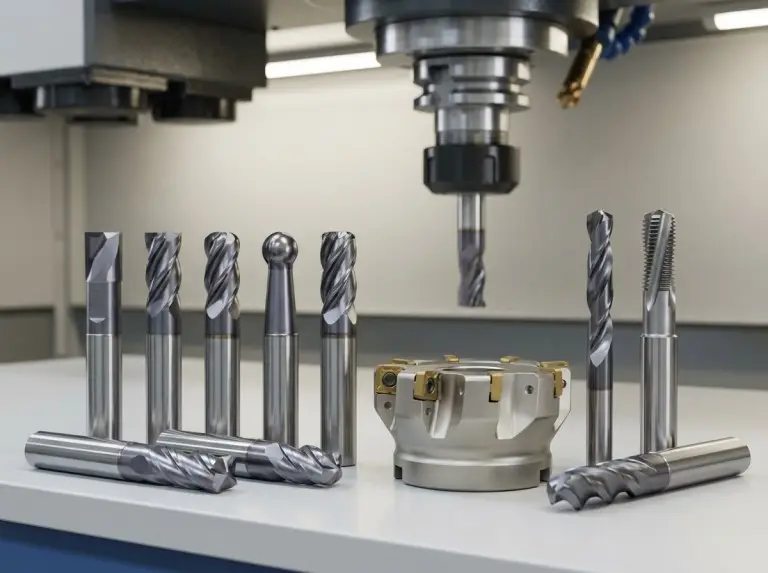
Good tool selection is key to successful angle milling. Single-angle and double-angle milling cutters are two of the most common types.
- Single-angle milling cutters: These cutters have a tapered cutting edge on just one side. Common angles are 30°, 45°, and 60°. They are good for making one-sided chamfers or slopes. When a part needs an angle on only one side, a single-angle cutter is a good choice. It can control the slope’s position and direction precisely. You can find these cutters in many angles and diameters to meet different needs.
- Double-angle milling cutters: These cutters have tapered cutting edges on both sides. From the side, they look like an inverted “V”. They are best for machining V-grooves and symmetric chamfers. They are very useful when you need to create a symmetric feature in one pass. This reduces the number of toolpaths. For example, you can finish the top and bottom chamfers of a hole in a single pass. This saves time from changing tools.
Other tools are also used for angle milling. These include chamfer mills, dovetail cutters, and countersinks. Their cutting edges have a fixed angle. By choosing the right toolpaths, you can create controlled slopes or chamfers on a part. Using a smart combination of these tools is often cheaper and easier than using special fixtures.
Execution Method of Angle Milling
At Yonglihao Machinery, angle milling is a complete process, not just a quick step. It starts when we receive the drawing and follows these stages:
Step 1: Process planning and drawing analysis
First, we identify all angle features on the drawing. We see which ones are simple chamfers. We also check which ones affect welding, sealing, or load transfer. Those need their own tolerance control. Then we think about how to machine them. Can we do it in one setup? How many coordinate systems do we need? What inspection tools are best for measuring them later?
Step 2: Workpiece fixturing and datum establishment
We choose the right fixture based on the part’s shape. This could be a vise, angle plate, or indexer. When clamping, we must use locating surfaces correctly. This ensures the part is truly located, not just held. Then we use tools like dial indicators and angle gauges. We align the workpiece with the machine’s coordinate system. This becomes the basis for all angle calculations.
Step 3: Tool selection and cutting parameter setup
We look at the material and angle type. We decide whether to use a straight end mill with a fixture or a special angle cutter. We usually start with conservative parameters. We reduce the spindle speed and cut depth slightly. This ensures the first part machines smoothly. We listen for normal cutting sounds and check the chips. Then, we slowly optimize the parameters.
Step 4: Trial cutting, adjustment, and mass production
We perform trial cuts on scrap metal or a sample piece. We check if the angles, widths, and surface quality meet the needs. We adjust tool compensation, offsets, and cutting parameters if needed. Once everything is correct, we start batch machining. We watch for tool wear, machine condition, and chip removal.
Step 5: Inspection and quality control
Simple chamfers can be checked with protractors, angle gauges, and calipers. Critical angles need more precise tools, like optical comparators or CMMs. For mass production, we use a clear strategy.
- We fully inspect the first piece.
- We sample parts during the process.
- We also confirm the last piece.
This ensures all angles are within tolerance for every batch.
Which Factors Most Affect Angle Milling Quality?
To keep angle milling stable, you must control three main things. These are parameters, rigidity, and cooling.
For parameters, cutting forces are more complex than in flat milling. This is especially true on steep, long slopes. Using aggressive parameters from flat milling can cause problems. You might see heavy vibration, angle errors, and chipping. The common strategy is to use many shallow cuts instead of one heavy cut. A slower cutting speed can also lead to a more stable cut.
For rigidity, the cutting force on a slope often pushes the workpiece sideways. This means the whole system must be very stable. If a part is just held in a standard vise without side support, it might move. This movement can lead to angle and size errors. For thin or long parts, we often use special supports or custom fixtures to improve rigidity.
For cooling and chip evacuation, different milling materials have different needs. Steel and cast iron need enough coolant to remove heat. This prevents the tool edge from getting too hot. Stainless steel and titanium alloys can get harder if they get too hot. This makes them much harder to cut. Aluminum and copper can get build-up on the tool if chips are not cleared well. This can scratch the surface. The space around angled areas is tight, so coolant nozzles must be aimed well.
Advantages & Limitations of Angle Milling
Angle milling has clear benefits but also some limits. Understanding both helps you make better process choices.
Here is a simple breakdown:
|
Dimension |
Advantages |
Limitations / Costs |
|---|---|---|
|
Accuracy |
Angles and sizes can be controlled well, much better than hand grinding. |
Tighter angle tolerances require better fixtures, machines, and inspection. This raises cost and setup time. |
|
Efficiency |
Multiple slopes can be done in one setup, reducing extra steps. |
Planning and setup time is often 15%–40% longer than for flat milling. |
|
Tool life |
With good parameters, carbide tools can machine many parts. |
Side forces are greater, so tools wear out 20%–50% faster than in standard milling. |
|
Applicability |
Can machine features like dovetail grooves and deep V-grooves that are hard to make otherwise. |
Not good for very large angles (over 70°) or very thin parts. Other processes might be better. |
|
Overall cost |
For larger batches, it can be cheaper than manual finishing. |
For small batches or high precision, setup and tooling costs are higher, so the price per part goes up. |
For manufacturers, the main benefits are consistency and lower overall cost. For designers, the limits are important to know. Not every complex angle you can draw is easy to mill. For some extreme angles, other processes like grinding or EDM might be better. Sometimes, a design change is the best solution.
Safety Considerations
Angle milling has some extra safety risks compared to regular milling. The direction chips fly is harder to predict. The side forces on the tool are also larger.
When cutting slopes or V-grooves, chips often bounce off the angled surface. Their paths are not regular. They might even fly out from unexpected directions. Operators should wear full-face shields, not just safety glasses. This protects them from high-speed chips.
The side forces in angle cutting are greater. If the workpiece is not clamped securely, it could move or be thrown from the machine. The tool could also chip or break. After tilting the workpiece or milling head, all axes must be locked properly. If they move during cutting, it can ruin the part and create a safety hazard.
For materials like aluminum, which make long chips, you need good protection. Use high-pressure coolant and chip guards. This stops long chips from wrapping around the tool or fixture.
Common Errors and Recommendations
Many hard lessons can be avoided. Here are some common errors and how to prevent them:
Error 1: Directly copying flat milling parameters
- Problem: You see heavy vibration and tool marks right away. The angles and dimensions are wrong.
- Cause: The original parameters are too aggressive for angle cutting.
- Recommendation: For the first part, reduce speed, cut depth, and feed rate by 30%–50%. Then, slowly optimize them based on trial cuts.
Error 2: Clamping without precise angle location
- Problem: The angle looks okay, but measurements show it is off by 0.5° or more. Parts in a batch have different angles.
- Cause: The slope was set by eye, without a precise reference.
- Recommendation: For critical angles, use tools like sine plates or angle blocks. Check the first part with an angle gauge or a CMM.
Error 3: Bad cooling when machining aluminum
- Problem: Chips stick to the tool. The sloped surface has scratches. The surface finish is poor.
- Cause: Heat is not removed well, and aluminum builds up on the tool edge.
- Recommendation: Use minimum quantity lubrication (MQL) or alcohol-based coolants. Blow chips away quickly. You can also reduce the spindle speed.
Error 4: No in-process sampling
- Problem: A whole batch of parts has angle errors. You have to rework or scrap them all.
- Recommendation: Set up simple checks. For example, sample a part with an angle gauge every 5–10 pieces. If you find an error, you can fix the problem right away.
Cost Factors
The price of angle milling is usually 20%–80% higher than for flat milling. This is due to more complex fixtures, tools, and inspection. The main cost drivers are:
- Angle tolerance requirements: If the angle tolerance is very tight (±0.1° or less), it means more trial cuts and inspection time. This can raise costs by 30%–50%.
- Equipment and tooling: If you need special cutters, angle heads, or 5-axis machines, there is an extra cost. This premium is usually 20%–40% to cover machine and setup costs.
- Material difficulty: For materials like titanium and stainless steel, tool and cooling needs are higher. Tool use is also much faster. Shops often add a 50%–100% surcharge for these materials.
- Batch size: For small batches (under 10 pieces), fixed costs are hard to spread out. The price per part is often double or more. For larger batches, angle milling can be cheaper than manual work.
When you design a complex angle, think about function and cost. Talk to your manufacturing partner. Ask if changing the angle tolerance or structure can lower the cost while still meeting your needs.
Tolerances & QA
Many people ask, “How accurate can angle milling be?” There is no single answer, but we can give a reference range.
- On a standard 3-axis machine, achieving ±0.3° to ±0.5° is a good result.
- With precision angle fixtures and a CMM, tolerances can be pushed to the ±0.1° range.
- With high-end 5-axis machines and stable processes, it is possible to hold angles at ±0.05° or better.
For inspection, we usually combine different tools:
- Digital angle gauges: Good for quick checks on the shop floor.
- Optical comparators: Good for looking at profiles and local angles.
- Coordinate measuring machines (CMMs): Used for formal reports, especially for critical angles.
At Yonglihao, we choose the right inspection tools for each part. We can provide CMM records for critical angles as part of our quality traceability. custom cnc milling and rapid prototyping company projects especially benefit from strict QA, as these parts often include multiple angled or unique features.
Common Applications of Angle Milling
Angle milling has different roles in different industries. The main goal is always the same: to meet a geometric need while balancing cost and reliability.
In aerospace and automotive, angle milling creates details related to loads and fluid flow. Examples include slopes on wing ribs and engine housings. Correct angles and surface quality reduce stress. They also improve flow and provide a good base for assembly.
In the mold industry, angle milling is used for draft angles on plastic molds and chamfers on stamping dies. Proper slopes help parts release from the mold. They also increase mold life and make polishing easier.
In medical and precision equipment, angle milling removes sharp edges while keeping function. Chamfers on bone plates and surgical tools must not harm soft tissue. They must also ensure parts fit and move smoothly. The standards for consistency and surface finish are very high.
Conclusion
At Yonglihao Machinery, we see angle milling as a key capability. It requires careful design and constant improvement.
With our 3-axis and multi-axis machines, a large stock of angle cutters, and our fixture design experience, we can help you with:
- Complete angle milling solutions for prototypes and mass production.
- Stable machining of materials like aluminum, carbon steel, and stainless steel.
- Process advice for critical angled parts like welding bevels and sealing tapers.
- Quality inspection methods, including CMM reports for full traceability.
- Integrated services that combine milling with turning, stamping, and more. This lowers your cost and risk.
If you have drawings with angled parts, send them to us. We can offer advice on feasibility, cost, and design improvements. We want to help you make sure your angled designs are both functional and easy to manufacture, no matter if it’s for a rapid prototyping company project or a large production order
FAQ
Is angle milling the same as “slope milling”?
Yes, they are basically the same idea. Any time you remove material at an angle other than 90 degrees to form a slope, it can be called angle milling.
Can stainless steel be angle-milled?
Yes, it can. But you must manage the tooling and cooling well. We typically use coated carbide tools with high-pressure coolant. We also use a strategy of many shallow cuts to avoid problems.
Do I need a 5-axis machine for angle milling?
No. A 3-axis machine can do most angle milling jobs when combined with angle fixtures or angled cutters. A 5-axis machine is best for complex surfaces with multiple angles, but it is not always needed.
What information should I prepare to outsource angled parts?
It is best to provide complete 2D/3D drawings, material type, critical angle tolerances, surface finish needs, quantity, and delivery date. Clear information helps our engineers design the best solution for cost, accuracy, and lead time.