

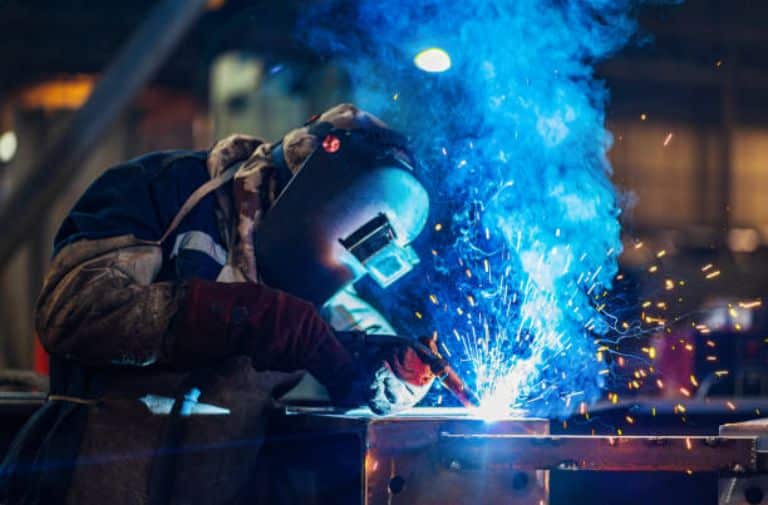
Welding joints define how two parts meet. This geometry directly impacts strength, distortion risk, and long-term durability in weld fabrication. In production, the joint choice also affects repeatable fit-up, heat input, and rework needs. A good joint is not just strong on paper. It must be weldable with your access, tolerances, and part volume. It should not force the welder to fill gaps with weld metal. This guide covers the five main types of welding joints. We will explore what they are, where they work best, and where they tend to fail.
What Is a Welding Joint?
A welding joint is the geometry used to connect two or more parts by welding. It describes how the parts are presented to the weld. This could be edge-to-edge, overlapped, or at a right angle. So, it is a design concept first and a welding topic second.
In plain terms, it describes the “fit” between parts. This includes alignment, overlap, and angle. It is not the welding process (MIG/TIG/Stick). It is also not the weld type (fillet/groove). This distinction matters. Joint geometry determines realistic penetration. It also decides if one-side access is enough. It tells you if you need groove preparation, backing, or multiple passes to meet quality goals.
Key Factors That Determine Joint Choice
The right welding joint matches the part’s load, thickness, and weld accessibility. A “theoretically strong” joint may be hard to access or fixture. It might be sensitive to gaps. This often creates distortion and rework in real builds.
Key drivers are load direction, thickness, and required root fusion. You should also consider fit-up tolerance. Think about whether you can weld from one side or both. You must also decide if you need a flush outside profile or a sealed seam. In custom parts manufacturing, these factors decide reliability, cycle time, and repeatability.
Main Types of Welding Joints
Butt Joint
A butt joint joins two parts in the same plane. Their edges meet with or without a root opening. It is the go-to joint for a clean seam line and predictable load transfer. It also creates a minimal external profile. This is common in plate seams, tubing, and pipe. A flush contour reduces interference and simplifies later assembly.
Best fit: when you can control fit-up and need a clean seam.
Limitations: thicker sections often need groove preparation to get reliable penetration. This can be a square, V, U, or J groove, with a single or double bevel. If you try to force a thick butt joint with square edges, you usually trade strength for heat. You will either under-penetrate the root or overheat the part, causing distortion. Success depends on a consistent root opening, tight alignment, and a solid penetration plan that matches your access and inspection needs.
Lap Joint
A lap joint is formed when one piece overlaps another. The weld is placed along the overlap edge. The joint naturally increases the bonded area. It does not rely on perfect edge alignment. For this reason, it is often chosen for thin sheet, patch work, and mixed thicknesses. A butt joint in these cases would be too sensitive to gaps and burn-through.
Best fit: thin materials and simple assemblies.
Limitations: gaps in the overlap can trap moisture and contaminants. This increases corrosion and defect risk. From a design view, overlap consistency is key. Too little overlap reduces strength. Too much adds weight and can increase distortion. For applications in wet or harsh environments, lap joints need tighter fit-up and cleaner surfaces. This is because crevice conditions can speed up corrosion around the overlap.
T-Joint
A T-joint is created when one part meets another at about 90°, forming a “T” shape. It is widely used because it aligns naturally with many products. Stiffeners, ribs, and frame members often meet a plate or tube wall at a right angle. The joint can be welded with little edge prep on many thicknesses.
Best fit: when load is predictable and access is good. It is often welded from one or both sides.
Limitations: one-sided welding may be weak if the load reverses. A practical rule is to place weld metal on the side that will see tension. This is where the joint most wants to separate. As thickness increases, groove prep or double-sided welding becomes critical. It ensures fusion at the root and prevents cracks from starting at the intersection.
Corner Joint
A corner joint joins two workpieces at about 90° to form an “L”. It is common for boxes, frames, and enclosures. It supports square geometry and fast assembly. This is especially true in sheet metal, where parts are formed and then closed by corner welding.
Best fit: an open corner (V-shaped gap) can help access for welding. A closed corner can improve stiffness.
Limitations: thin sheet is prone to burn-through and distortion. Corner joints also magnify angular errors. Small fit-up gaps or misalignments become visible after welding. Heat shrinkage can also pull the frame out of square. Fixtures, balanced weld sequencing, and short intermittent welds are often key to a clean 90° result.
Edge Joint
An edge joint is made when two parts sit side-by-side. They are welded along the adjacent edges. It is usually selected for sheet components. The goal is closure or stiffness, not high structural loading. This is typical in light enclosures, ducting, and thin housings.
Best fit: cosmetic closure or low-stress seams.
Limitations: this joint is not a good choice for impact or high loads. The fused area is limited. If the design must carry a load, an edge joint often needs geometric reinforcement like flanges or hems. Adding more weld metal alone does not fix the basic load path issue. Treat it as a low-stress joint unless proven otherwise by engineering calculations and tests.
|
Joint Type |
Typical Geometry |
Best For |
Common Limitations |
|---|---|---|---|
|
Butt |
Same plane, edge-to-edge |
Flush seams, pipe/plate seams |
Needs groove prep for thick sections; fit-up sensitive |
|
Lap |
Overlap |
Thin sheet, mixed thickness |
Gap/corrosion risk; visible; heat distortion on thin sheet |
|
T-joint |
90° intersection |
Frames, brackets, stiffeners |
Load reversal risk if one-sided; thick sections may need prep |
|
Corner |
90° “L” |
Boxes, frames, enclosures |
Angle distortion; burn-through on thin sheet |
|
Edge |
Side-by-side edges |
Low-stress sheet closures |
Not for impact/high loads; limited fused section |
When to Use Which Joint?
Choose the right joint by matching its geometry to the load direction, thickness, accessibility, and appearance needs. If you pick the geometry first, selecting the process and weld type becomes much simpler. In custom parts manufacturing, this step also reduces quoting risk. The wrong joint can double welding time through extra prep, fixturing, and rework, even if the part looks simple on a drawing.
Quick selection checklist:
- Load & stress direction: tension, shear, or bending, and whether load reverses.
- Material thickness: thin sheet vs. thick plate (drives need for groove prep).
- Access: can you weld from one side or both sides?
- Fit-up tolerance: can you control gaps, alignment, and root opening?
- Appearance / flush requirement: flush seam needed (butt) vs. overlap acceptable (lap).
- Distortion sensitivity: thin parts and long seams need more control.
Fast rules that work in most shops:
- Need a flush seam → start with a butt joint. Add groove prep as thickness increases.
- Joining thin sheet quickly → consider a lap joint. Control overlap and avoid gaps.
- Building frames/brackets → a T-joint is usually the default.
- Making boxes/enclosures → a corner joint is common. Fixture it to hold the angle.
- Closing low-stress sheet edges → use an edge joint, but avoid it for load-bearing parts.
When you are torn between two joint types, decide based on what you can control. If you cannot guarantee tight alignment, prefer the geometry that tolerates it. If you cannot weld both sides, avoid designs that need it to be reliable.
Fit-Up & Preparation Essentials That Drive Joint Quality
Great joints come from fit-up discipline more than from welder skill. Most failures trace back to gap control, penetration planning, and heat distortion control. Fit-up is about making the joint easy to weld. It requires consistent contact, repeatable root conditions, and stable restraint. This helps the weld pool behave the same way every time. Once gaps vary, the welder must improvise with heat and filler. This increases defect risk and makes distortion unpredictable.
Fit-up essentials that apply across all joint types:
- Clean contact surfaces: remove oil, scale, and paint at the joint area.
- Control gaps and alignment: tack weld and fixture so the joint does not move.
- Use the right edge preparation: square edges work on thin material. Thicker sections often need beveled grooves for good penetration.
- Plan access and sequence: long seams and thin sheets benefit from staged tacks, skip welding, and balanced sequencing to reduce distortion.
Remember, fillet and groove are weld types used to fill a joint. Butt, lap, T, corner, and edge define the joint geometry. Select the joint first. Then apply the weld type that achieves the required fusion.
Common Joint-Related Problems and How to Prevent Them
Many weld defects are geometry and access problems first, not welder skill problems. Most recurring shop issues trace back to a few root causes. These include poor access to the root, bad joint prep for the thickness, or inconsistent fit-up. Fixing these upstream issues improves weld quality faster than adjusting machine settings.
|
Issue (Joint-Linked) |
Where It Shows Up Most |
Typical Cause |
Prevention Handle |
|---|---|---|---|
|
Incomplete penetration |
Butt, thick T-joint |
No groove prep, poor root opening |
Add proper groove prep, control root opening, plan for fusion |
|
Burn-through |
Thin butt, open corner, lap on sheet |
Too much heat, poor gap control |
Tight fit-up, staged tacks, faster travel, heat control |
|
Distortion / angle drift |
Corner, long lap seams |
Heat buildup, weak fixturing |
Use fixtures, a balanced sequence, and shorter runs |
|
Crevice corrosion risk |
Lap, some edge joints |
Trapped moisture in gaps |
Ensure tight overlap, clean surfaces, and avoid gaps |
|
Cracking at stress concentration |
Sharp corners, restrained joints |
High restraint, poor root fusion |
Improve fusion, reduce restraint, use proper transitions |
Conclusion
The five main types of welding joints are butt, lap, T, corner, and edge. They are simple to name but easy to misuse. You must consider load direction, thickness, and access. A reliable joint is one your team can produce repeatedly. It fits without forcing and allows for the needed fusion. It does not rely on extra weld metal to fix poor geometry. Keep your selection logic tight, starting with geometry, then weld type. Control your fit-up, including gaps, alignment, prep, and distortion. You will get joints that are not only stronger but also more repeatable in production.
FAQ
What are the most common types of welding joints?
The most common types are butt, lap, T-joint, corner, and edge joints. Different products favor different joints. T and corner joints are common in frames. Butt joints are common in aligned seams and piping.
Which welding joint is usually the strongest?
A properly designed and fully fused butt joint is often the strongest. It can create a continuous cross-section through the seam. But the result depends on fit-up, penetration, and defect control, not the joint name alone.
How do I choose between a butt joint and a lap joint?
Choose a butt joint when you need a flush profile. You must also be able to control alignment and root conditions. Choose a lap joint for thin sheet or mixed thickness. You must ensure the overlap is tight with minimal gaps.
When should I avoid an edge joint?
Avoid an edge joint when the part will see impact or high loads. Only the edges are fused, so its load path is limited compared to other joints.
What’s the biggest cause of joint failure in real production?
Poor fit-up is the most common root cause. This is especially true for uncontrolled gaps and misalignment. When fit-up drifts, the welder is forced to “fill problems.” This increases burn-through, lack of fusion, distortion, and rework.


